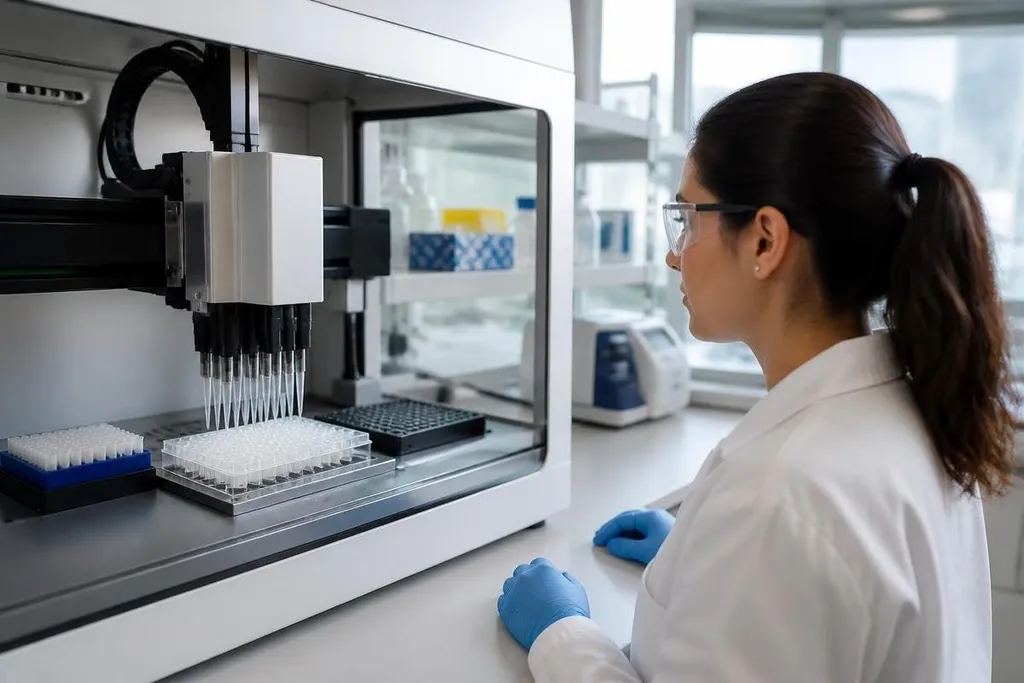
A research robot can repeat the same pipetting motion across a 96-well plate without tiring or changing its hand position. That matters because many experiments depend on small changes in liquid volume, timing, temperature, or mixing.
For a lab team, the useful question is where automation removes delay without hiding mistakes.
- Robots repeat set steps with the same timing.
- Sensors and software record what happened during each run.
- Scientists still decide which questions are worth testing.
Where robots save time
A typical automated workflow starts with liquid handling. The robot moves samples between tubes, plates, and test vessels, then adds reagents in a set order. Reagents are substances added to cause or measure a reaction.
That repeat work can take up a large part of an experiment. A system may handle a 96-well plate for one test and a 384-well plate for a larger set of conditions. The plate format changes how many tests fit into one run, while the liquid volume and mixing method affect the result.
Automation also keeps the work moving between steps. A robot can place a plate in an incubator, return it for imaging, and send the image files to software for review. The scientist spends less time carrying samples and more time deciding what the measurements mean.
Repeatable work creates better comparisons
Discovery often depends on comparing many small changes. A drug screen may vary the dose, exposure time, or cell type. A materials lab may change the mixture or heating cycle. In each case, the result is useful only when the team knows which conditions changed.
Robots help by following a written procedure. The software can record the sample ID, tool position, liquid volume, and time of each step. That record makes it easier to find a bad result and repeat the same test.
Repeatability has limits. A robot can repeat a poor procedure with great accuracy. It can also spread a problem from one sample across a whole plate if the liquid tool is dirty, the calibration is wrong, or the software uses the wrong file.
That is why a good automated lab checks the process before it runs a large batch. The team needs controls, clear sample labels, and a way to stop the system when a reading falls outside the expected range.
Robots can connect separate lab steps
Many research tasks slow down at the handoff between tools. One device prepares a sample, another measures it, and a person moves the material between them. Each handoff adds time and creates a chance for a label, volume, or position error.
A connected setup can move the same sample through several steps. It may combine liquid handling, incubation, imaging, and data collection in one scheduled run. The benefit comes from the link between those steps, not from the robot arm alone.
That scheduled handoff gives researchers a way to compare results across runs. Research robotics reporting from Robot24.com can place these lab systems beside their test dates, software limits, and human checks. That record matters when a faster run still produces data the team can't trust.
Software also changes the pace of discovery. A program can select the next test from earlier measurements, but the rules still come from the research team. The system needs limits for temperature, volume, sample count, and safety before it can run unattended.
What stays with the research team
Robots handle repeatable steps. They don't decide whether a result answers the scientific question. People still choose the test, set the controls, check the data, and decide whether a result deserves another run.
The hardest work may sit before automation begins. A lab must define the procedure in enough detail for software to follow it. That means naming each sample, fixing the order of operations, setting tool limits, and recording the conditions that could change the result.
I’d choose a slower system with clear records over a faster system that leaves gaps in the experiment log.
A practical check before buying
Use this list when a lab is weighing a research robot:
- Start with one repeat task: pick a process that already has written steps and a clear output.
- Check the liquid range: confirm that the robot can handle the smallest and largest volumes in the procedure.
- Test the handoffs: see how samples move between plates, storage, imaging, and measurement tools.
- Review the records: check whether the software saves sample IDs, times, settings, and errors.
- Plan the stop point: set a safe way for a person to pause the run and inspect a problem.
The best first project is usually a narrow workflow with many repeated steps and a clear pass or fail result. Once the lab can trace every sample through that run, it has a sound basis for adding more tools and more tests.